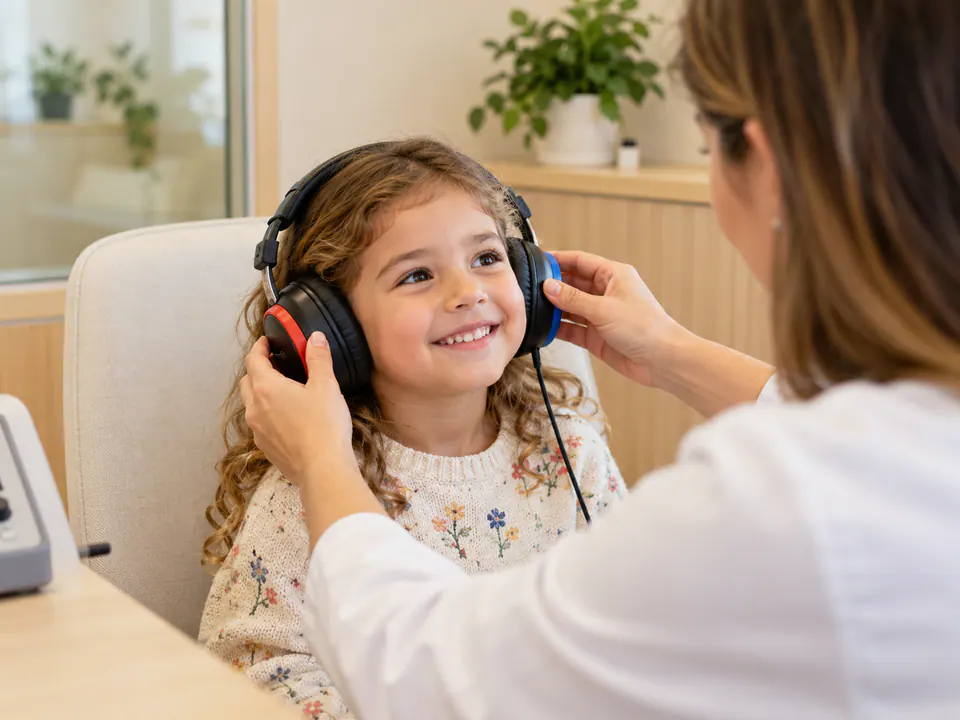
Our pediatric services include hearing evaluations, treatment, hearing protection, hearing aids, implants and speech therapy for infants and children. We use age-appropriate testing and tailor care to each child’s needs. For younger children we focus on speech and language development; for older children we prioritize clear hearing for success in school. We support both the child and the family throughout care.
Newborn hearing screening
Newborns are screened for hearing before leaving the hospital. Most have typical hearing, but about 2 to 3 in every 1,000 babies in the United States are born with a detectable hearing loss in one or both ears.
Source: NIDCD, Quick Statistics About Hearing (opens an external website)
The screening is a simple pass/fail test. If a baby doesn’t pass, further evaluation by an audiologist is needed. Early detection is key: babies who receive intervention by 6 months often develop strong language and learning skills.
Pediatric hearing tests
Pediatric hearing tests are non-invasive and give detailed insight into the degree and cause of a hearing loss and the treatment options. They go beyond newborn screening to help us understand a child’s hearing more fully.
Behavioral
Visual reinforcement & play audiometry
Age-appropriate listening games that measure how a child responds to sound.
Inner ear
Otoacoustic emissions (OAE)
A small probe detects sound responses from the inner ear.
Hearing pathway
Auditory brainstem response (ABR)
Tracks brain activity in response to sound while the child rests.
Pediatric hearing loss
Hearing loss can be present at birth or develop during childhood. Causes include genetics, certain medications, frequent ear infections, loud noise exposure and head injuries. Some cases may not be reversible.
Signs vary with age and developmental milestones. Early support — hearing aids, implants, therapy or sign language — can greatly improve brain development, communication and learning.
Explore speech and hearing milestonesFor our youngest patients
Kids’ corner
What happens at a hearing test?
A kid-friendly look at a visit — great for reading together before the appointment.
Say hello
You’ll meet a friendly audiologist in a room made for kids.
Play listening games
You might turn toward a sound, or play a game each time you hear one.
Tiny microphones and naps
A soft ear tip can check how your inner ear answers sounds — and some babies simply rest while special stickers listen to the hearing nerve.
You did it!
Grown-ups talk about the results, and you’re done.
Hearing aid coverage for children
California’s Hearing Aid Coverage for Children Program (HACCP) offers hearing aid benefits for eligible children. Learn what the program covers and where to find official applications and eligibility rules.
Explore children’s coverageSupport for the whole family
Family resources
Communication options, therapy, local resources and the Ling Six Sound Test.
Speech & hearing milestones
What to look for from birth to 8 years.
Listen Through Literacy
Building confidence through listening, reading and learning.
Common questions
- What ages do you see?
We care for patients from newborns to seniors, and use age-appropriate testing for babies, young children and school-age kids.
- Do you offer newborn hearing screenings?
Yes. Our practice offers newborn screenings using auditory brainstem response (ABR) testing, which measures how the hearing nerve responds to sound. If a baby doesn’t pass a screening, further evaluation by an audiologist is needed.
- What tests are used for children?
Depending on age, visual reinforcement and play audiometry (listening games), otoacoustic emissions (OAE) and auditory brainstem response (ABR). All are non-invasive.
- How can I prepare my child?
Read our kids’ corner together before the visit, and ask our team how to prepare your child for the appointment.
- Is there help paying for children’s hearing aids in California?
California’s Hearing Aid Coverage for Children Program (HACCP) offers hearing aid benefits for eligible children.
Questions? We’re here to help.
Connect with our team for guidance about your care or your family’s next steps.